
Sprinkler repair that traces the problem back to its cause
Sprinkler repair at Rainfall Irrigation starts with finding out why a head, zone, or valve stopped doing its job, and then fixing that cause instead of only the symptom. Our licensed technicians test the system zone by zone, make the repair, and set the heads so water lands on the lawn again.
Ryan was courteous, knowledgeable, and took the time to resolve our issues. He also evaluated the entire system and recommended improvements that could increase performance and efficiency. We were very satisfied with his work.
What is your system doing?
Tap each sign you have noticed on your property. The meter fills as you go and tells you what that mix of symptoms usually means. It is a starting point for a phone call, and a technician on site confirms the real cause.
Common sprinkler problems, explained by the people who fix them
Most sprinkler trouble comes from a short list of parts: the heads, the buried pipe, the zone valves and their wiring, and the controller that tells everything when to run. The symptom you see in the yard is often a step or two away from the part that failed. This is what our technicians look for first.
Broken, stuck, sunken, or misaligned heads
A head that will not pop up is often packed with dirt or sand, has a worn seal, or has settled below the grass over the years. Heads that stay up usually have debris jammed around the riser. Cracked caps and bodies usually come from a mower, a car tire, or foot traffic, or from water that froze inside the head over the winter.
Heads are also the usual cause of dry patches in a zone that otherwise runs. A head knocked out of line, tilted, set to the wrong arc, or blocked by a clogged nozzle leaves a strip of lawn without water, and shrubs that have grown in front of a head over a few seasons can block its spray just as well.
Geysers, leaks, and soggy spots
A geyser means a head or the riser under it has snapped off, so water leaves the pipe with nothing to shape it. A wet patch that never dries points to a cracked pipe, a loose fitting, or a valve that seeps.
Low pressure across a zone
When a whole zone sprays short, the usual causes are a hidden leak on that zone, a clogged nozzle or filter, a valve that is not opening fully, or more heads on the zone than the water supply can carry.
Zones that will not turn on or off
A zone that stays off usually has a failed solenoid on its valve or a broken wire to the controller. A zone that will not shut off is most often a valve held open by debris or a worn diaphragm inside it.
Controller and rain sensor faults
A controller can lose its schedule after a power outage, develop a loose wire at the terminals, or fail with age. A system that waters in the rain usually has a sensor that is damaged, dirty, disconnected, or set to bypass.
A repair visit, in the order the work happens
A good sprinkler repair follows the water. The technician starts at the controller, works out to the zones, and does not call the job done until the repaired area has been run again and the coverage looks right.
- 1
Run the system zone by zone
Each zone is started from the controller, one at a time, while the technician walks it and watches every head: which ones rise, which spray short, and where water collects.
- 2
Find the fault
The symptom is traced back to its source. That can mean digging at a wet spot to expose a cracked pipe, testing a valve and its solenoid, following the wiring, or checking the controller program and rain sensor.
- 3
Make the repair
Broken heads, risers, and nozzles are replaced, cracked pipe and fittings are cut out and repaired, valve parts are cleaned or replaced, and damaged wire is spliced with connections made for burial.
- 4
Test the repair
The repaired zone runs again, along with the zones around it, to confirm the leak is gone, the valve opens and closes cleanly, and nothing new turned up.
- 5
Adjust the coverage
Heads are set straight and level with the grass, arcs and spray distance are adjusted so water reaches the lawn and beds instead of the driveway or the house, and the controller program and rain sensor are checked before the technician leaves.
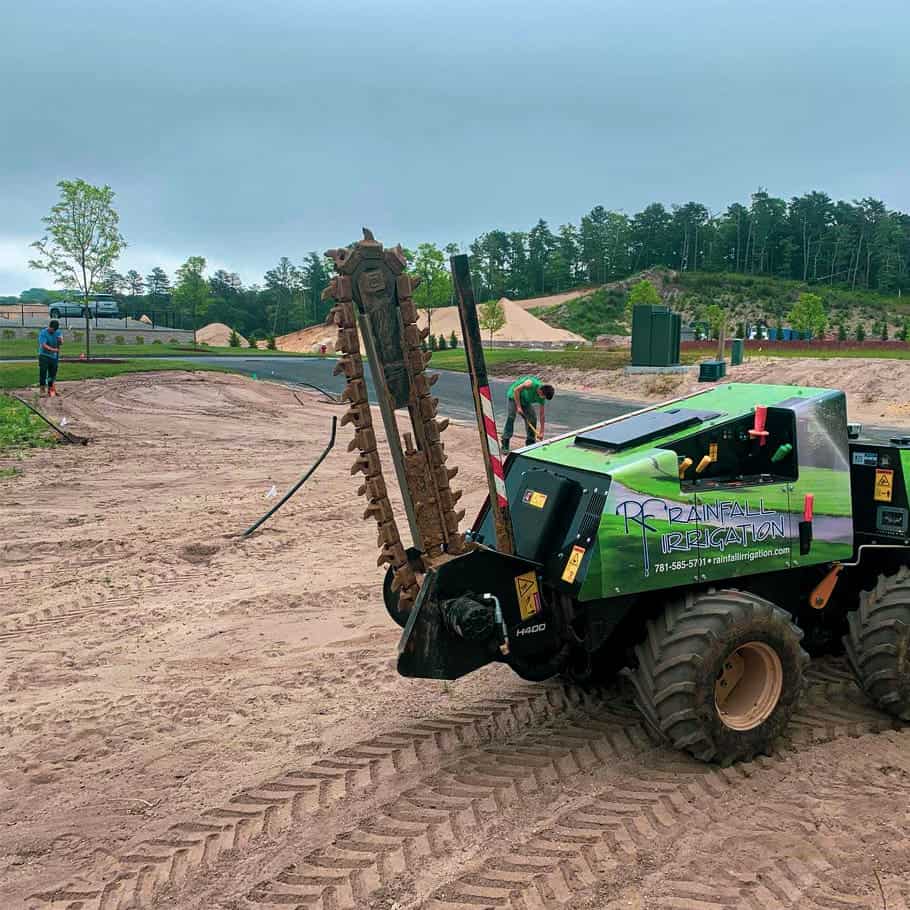 Rainfall irrigation project
What the technician inspects while the system is running
While the affected zones are running, the technician also checks the parts that often fail alongside the one you called about.
| Part | What the technician looks for |
|---|---|
| Heads and nozzles | Each head rises fully, drops back down, and sprays the pattern it should without clogs or cracks. |
| Head height and alignment | Heads sit level with the grass, stand straight, and point where the water is needed. |
| Pipe and fittings | Wet ground, pooling, or a sudden drop in pressure that points to a leak underground. |
| Zone valves | Each valve opens on command, closes fully, and does not seep between cycles. |
| Valve wiring | Connections at the valves and the controller are intact, dry, and free of corrosion. |
What winters and yard work do to a sprinkler system here
Sprinkler systems in Massachusetts sit through months of frozen ground, snow, and plowing before they ever run in spring. Much of the repair work our irrigation services team sees each year comes from that, and from the everyday traffic a lawn takes all summer.
Freeze damage found at start-up
Water left in a pipe, valve, or backflow device can freeze and crack it over the winter. The damage stays hidden until the water goes back on, so a careful spring sprinkler start-up often turns up the first repair of the year.
Mower and plow damage
Heads along driveways, walks, and the street edge take the most abuse. Snowplows scrape them off in winter, and mowers clip heads that have risen or tilted during summer. Setting heads at the right height cuts down on repeat breaks.
When a repair is enough, and when an upgrade makes more sense
Most sprinkler problems are repairs. A broken head, a cracked pipe, or a stuck valve is a contained fault, and fixing it puts a sound system back to work. The picture changes when the same kind of failure keeps coming back, which means parts have worn out rather than broken once. In those cases we may suggest replacing a group of heads, rebuilding the valves, or moving to a smart irrigation controller that adjusts watering to the weather. When most of a system has worn out, a new sprinkler system installation can make more sense than chasing repairs zone by zone.
| Repair usually makes sense when | An upgrade is worth a look when |
|---|---|
| One head, one section of pipe, or one valve has failed. | The same kind of part keeps failing season after season. |
| The pipe and valves are otherwise in sound condition. | Several valves or many heads have worn out around the same time. |
| The controller keeps its program and runs every zone. | An old timer keeps losing its schedule and cannot adjust to the weather. |
| Coverage was even before the problem started. | Coverage stays uneven even after the heads are adjusted. |
What decides the cost of a sprinkler repair
The cost of a sprinkler repair depends on what failed and how hard it is to reach. Swapping a head or nozzle is a smaller job than repairing a valve or a buried pipe, and one fault costs less to fix than several across a few zones.
Location matters too. A leak under open lawn is easier to reach than one under a walk or planted beds, valve boxes buried under grass or mulch take time to find, and a broken wire underground takes longer to trace than a loose connection at the controller.
Parts count as well. The parts a repair needs, and whether an older component is still easy to match, change the total. If a part is hard to match, we talk through the options before the work goes ahead.
Keep the same problem from coming back
Many repairs could have been caught a season earlier: a tilted head, a valve starting to seep, a rain sensor knocked loose. Regular seasonal service puts a technician on the system while it runs, when those faults are easiest to spot.
Questions customers ask about sprinkler repair
Something not covered here? Call 781-679-1388 Monday to Friday, 8:00 AM to 4:00 PM, and tell us what your system is doing.
First turn the system off at the controller. If water keeps running, the valve for that zone is likely stuck open, so close the main shutoff for the irrigation system to stop the flow. Then call us to book a sprinkler repair visit so the valve can be cleaned or rebuilt.
Yes. We service existing systems, including ones we did not put in. The technician runs every zone, finds the fault, and repairs it the same way as on a system we installed. If an older part is hard to match, we explain the options before going ahead.
A short trickle right after a cycle is usually water in the pipe running downhill to the lowest head, and it stops once the line empties. If it keeps running long after the cycle ends, or the spot stays soggy, the zone valve may not be closing fully, which calls for a repair visit.
Sometimes it is only the schedule. A controller that lost power can drop its program, and a zone set too short can leave dry patches. If the schedule looks right and the problem continues, a head, valve, wire, or pipe is usually the cause, and a zone by zone sprinkler repair visit will find it.
Not always. After a Massachusetts winter, freeze damage is often a cracked head, fitting, or short section of pipe that is simple to replace. A cracked backflow device or valve is more involved. The spring start-up is when most of it shows up, so that is the best time to have it checked.
Tell us what your sprinkler system is doing
Describe the signs you have noticed, which zones are affected, and anything that changed recently, like a new patio or a hard winter. We will follow up to set up a repair visit.