
LED landscape lighting conversion for older halogen systems
An LED landscape lighting conversion takes the halogen lighting already in your yard and moves it to LED, using the wire runs and fixtures that are still sound. The result is steadier light, far fewer burned-out bulbs, and a system that uses much less power every night it runs.
- What we convert
Low-voltage halogen landscape lighting - Ways to convert
LED lamps in existing fixtures, new LED fixtures, or a mix - Checked along the way
Transformer, timer, wire runs, and connections - Office hours
Monday to Friday, 8:00 AM to 4:00 PM
Keep the layout you like and change what powers it
Many homes on the South Shore had low-voltage halogen lighting put in years ago. The plan often still works: the path lights mark the walk, the uplights catch the trees, and the transformer turns everything on at dusk. What wears out is the halogen itself. The bulbs run hot, burn out one by one, and the yard slowly gets dimmer and more yellow.
A conversion replaces that halogen with LED while keeping as much of the working system as makes sense. Some fixtures take an LED lamp in place of the old bulb. Others are past saving and get a new LED fixture in the same spot. Along the way, the transformer, timer, and connections get checked, because an LED lamp in a failing socket will not stay lit for long.
This is part of our landscape lighting services, alongside new design and installation and repairs on existing systems. You can see finished work in our project galleries.
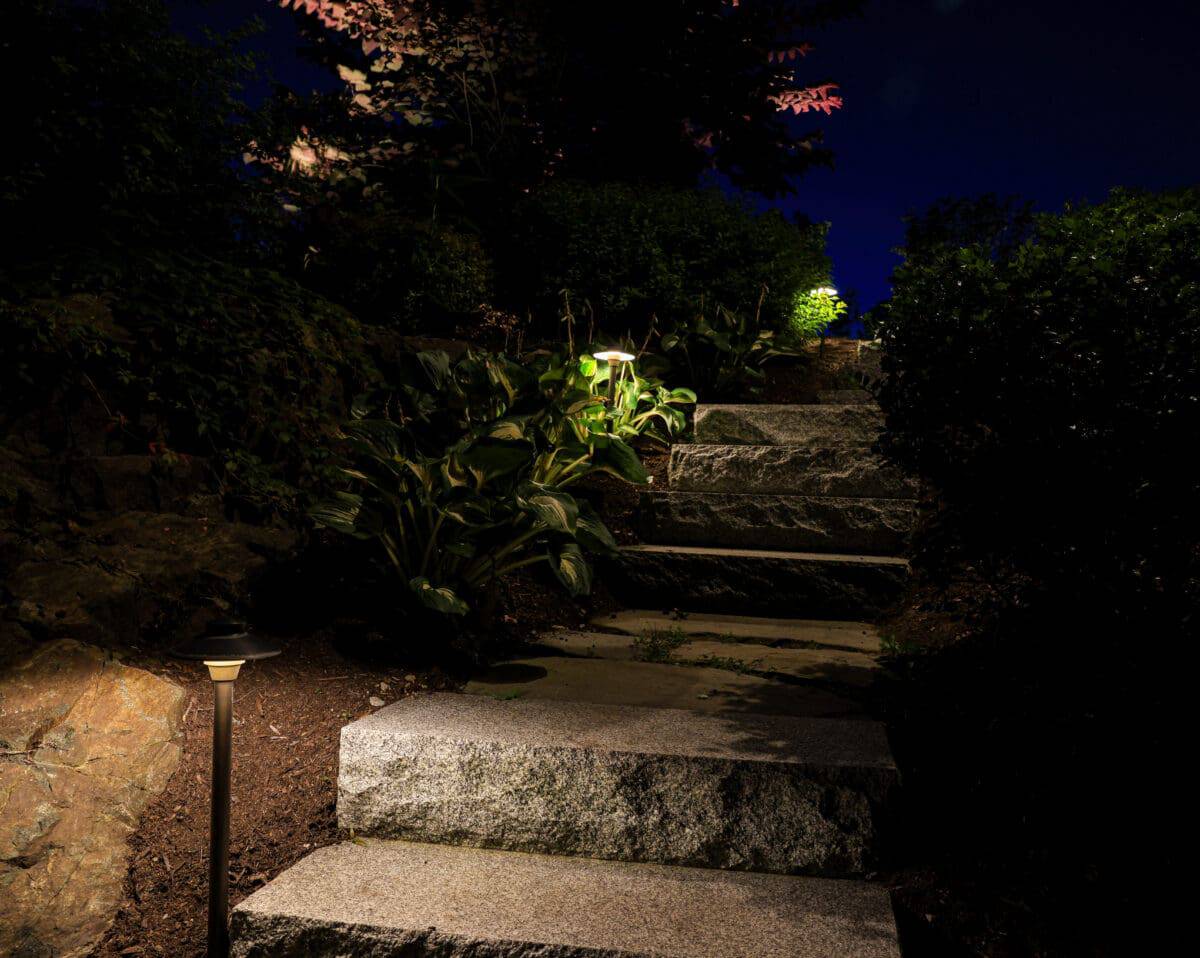 Landscape lighting project
Halogen or LED, fixture by fixture
Switch between the two to see how each part of the yard changes.
01A halogen system as it ages
- Path lightsWarm pools of light that fade as bulbs age, with a dark gap along the walk each time one burns out.
- Uplights and accent lightsHot bulbs inside a closed fixture are hard on lenses, gaskets, and sockets over the years.
- Wash lights on the houseOn a long, heavily loaded run, fixtures at the far end often glow dimmer than the ones near the transformer.
- BulbsThey burn out often, so replacing them becomes a regular chore and the yard is rarely fully lit.
- TransformerHalogen bulbs draw a heavy load, which limits how many more fixtures the transformer can take.
- Nightly power useThe system draws much more power for the light it gives, every night from dusk on.
02The same yard after an LED conversion
- Path lightsSteady light along the walk that holds its color, with far fewer burned-out gaps.
- Uplights and accent lightsLEDs run much cooler, which is easier on the fixture, and warm white keeps trees and stone looking natural.
- Wash lights on the houseA lighter load on each run helps the far fixtures glow closer to the near ones.
- LampsLED lamps and fixtures last much longer than halogen bulbs, so burned-out gaps are far less common.
- TransformerA lighter load can leave room on a sound transformer to add fixtures later.
- Nightly power useThe same layout uses far less power, which adds up over long fall and winter nights.
A general comparison. How your yard changes depends on the fixtures, wiring, and transformer you have now.
When a halogen system is ready for LED
Most homeowners call once the halogen lighting has become more work than it is worth. If two or three of these sound familiar, a conversion is worth a look.
If a whole section is dark rather than one light at a time, mention it when you call, since that is a wiring question to sort out as part of the conversion.
- Bulbs keep burning outYou replace one, and another goes a few weeks later.
- The light looks dim or yellowThe yard is not as bright as you remember, even with every bulb working.
- The far end is darkerFixtures at the end of a run glow weaker than the ones near the transformer.
- Fixtures show their ageCloudy or cracked lenses, corroded sockets, or stems that lean after a few winters.
- You want more lightsYou would like to add fixtures, but the transformer is already carrying a full halogen load.
Three ways to convert a halogen system
The right route depends on the condition of each fixture, not on a rule for the whole yard.
| Option | When it fits |
|---|---|
| LED lamps in existing fixtures | The fixture body, socket, and lens are in good shape. An LED lamp replaces the halogen bulb, the fixture stays where it is, and the look of the yard stays familiar. |
| New LED fixtures | Fixtures are corroded, cracked, or never lit the right thing. A new LED fixture goes in, with the chance to pick a better beam or a sturdier fixture in a spot that sees snow and shovels. |
| A mix of both | Most older systems land here. Sound fixtures get LED lamps, worn ones are replaced, and the whole yard ends up on LED with light that matches from one fixture to the next. |
An LED conversion, in the order the work happens
A conversion covers the fixtures, transformer, and wiring along with the bulbs. The order below is how the job is typically approached so the new lighting works the first night and keeps working.
Look at the whole system
Every fixture, the transformer, the timer, and the wire runs are checked, including which lights are dark, dim, or damaged today.
Choose lamp or fixture
Each spot gets an LED lamp or a new LED fixture, with a warm color and a beam that suits what it lights.
Convert and reconnect
Lamps and fixtures go in, and worn connections found along the way are repaired.
Turn it on and aim each light
The system is turned on, fixtures are aimed to cut glare, and the timer or dusk sensor is set so the lights come on when you expect.
What decides the price of a conversion
The price depends on the system you have now. These are the things that move it.
- How many fixtures you haveMore fixtures means more lamps or fixtures to convert.
- Lamps or new fixturesFixtures that only need an LED lamp cost less to convert than fixtures that need replacing.
- Transformer and timer conditionA sound transformer can often stay. An old or failing one, or a worn timer, adds to the job.
- Wiring and connectionsCut wires, buried splices, and corroded connections found along the way need repair.
- New lights added at the same timeExtending the system with new path or accent fixtures adds to the scope.
When you call, it helps to share roughly how many lights you have, which ones are out or dim, and where the transformer is mounted.
Ryan was courteous, knowledgeable, and took the time to resolve our issues. He also evaluated the entire system and recommended improvements that could increase performance and efficiency. We were very satisfied with his work.
Questions about moving from halogen to LED
Something else on your mind? Call 781-679-1388 during office hours, Monday to Friday, 8:00 AM to 4:00 PM.
Often, yes. Many halogen fixtures in good condition can take an LED lamp in place of the old bulb. Fixtures with corroded sockets, cracked lenses, or broken stems are better replaced. During an LED landscape lighting conversion we look at each fixture and tell you which ones can stay.
In many cases it can, because LED lighting puts a much lighter load on the transformer than halogen. The age and condition of the transformer and its timer still matter. If either is failing, we will recommend replacing it at the same time rather than after.
LED comes in a range of light colors, from warm white to a cooler blue-white. Warm white is the closest match to the glow of halogen, so most homes choose it. Color and beam are chosen per fixture so the yard keeps a consistent look.
Yes, and it is a good time to do it. The lighter LED load can leave room on the transformer for more fixtures. New path or accent lights can be planned as part of the same LED landscape lighting conversion so the old and new fixtures match.
Yes. LED lamps and fixtures draw much less power than halogen for the light they give, and the difference adds up over the long nights of fall and winter, when the lights run the most hours.
Ready to take your halogen lighting to LED?
Tell us about the lighting you have now: roughly how many fixtures, which ones are out or dim, and whether you would like to add any. We will follow up to talk through converting your system.